European Accredited Compact Excavators: The Handbook to Conformity
European Accredited Compact Excavators: The Handbook to Conformity
Blog Article
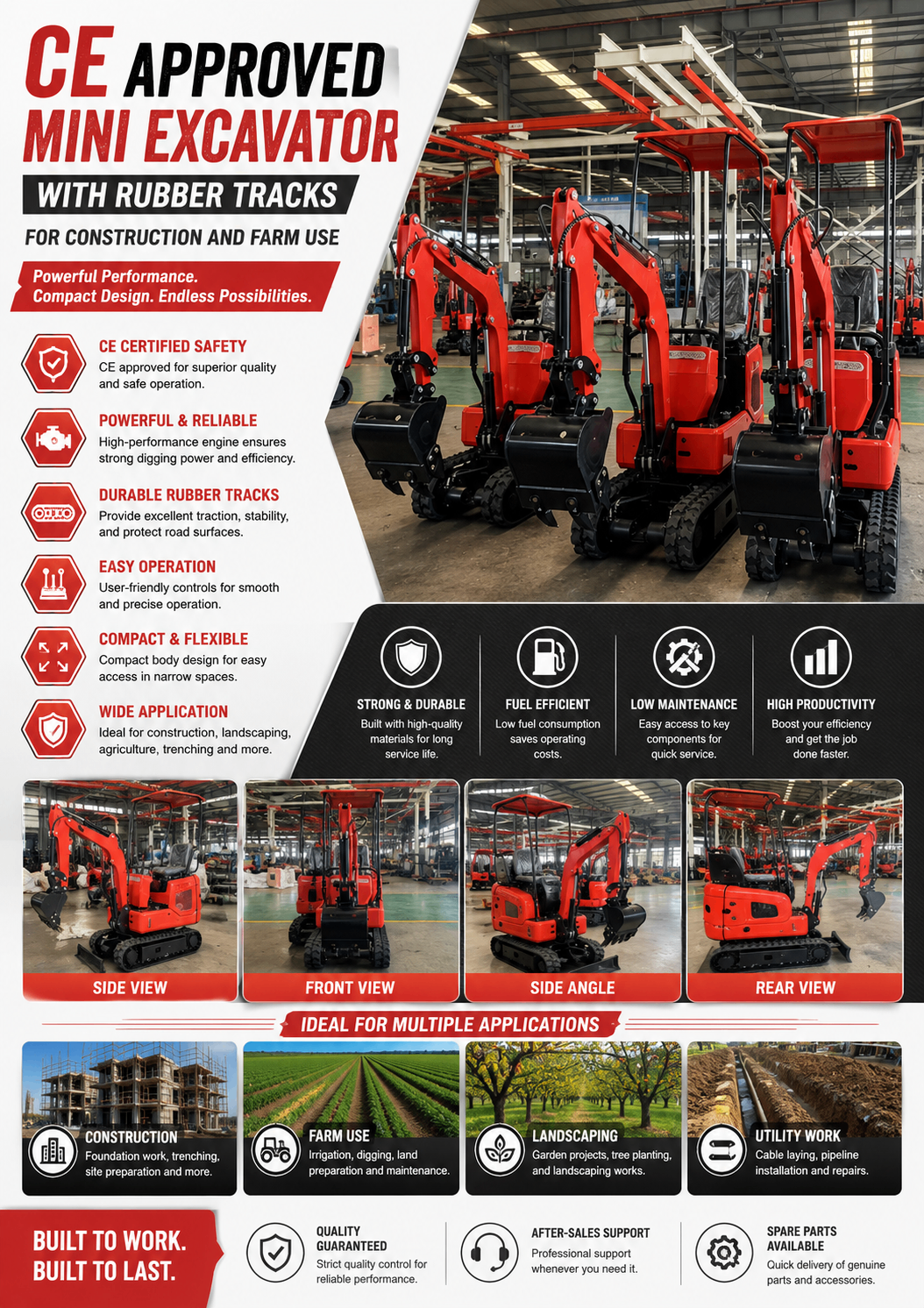
Ensuring your small excavator meets CE accreditation requirements is vital for market within the EU. Our overview details the important aspects of EU certification for small excavators, covering regulations related to security, machinery evaluation, and documentation. Grasping the rules permits companies to correctly use their machinery and prevent possible penalties.
Rubber Track Mini Machines: Excellent Grip for Difficult Terrain
Mini excavators equipped with steel tracks are transforming how contractors handle projects in rough conditions. Unlike traditional tire-equipped models, these flexible machines offer remarkable pull on slippery surfaces like mud, slush, and uneven hills. This greater control allows operators to finish work safely and quickly, minimizing downtime and maximizing performance. The flexible nature of composite tracks also lessens ground compaction, safeguarding delicate surfaces and minimizing ecological damage.
Small Excavators: Big Capability in Tight Construction Sites
These capable miniature excavators deliver a remarkable approach for tasks where large equipment simply maneuver. Their limited footprint enables access to restricted areas, including confined systems or between current buildings. Despite their scale, they possess substantial excavating ability and finesse, allowing them perfect for a broad scope of demolition applications. Ultimately, mini excavators embody a intelligent asset for developers facing the problems of confined workspaces.
Small Diggers for Agricultural Land : Flexibility and Effectiveness in Crop Tasks
Modern farming operations often require equipment that can handle a scope of difficult jobs. Compact diggers are quickly becoming invaluable assets for producers, offering get more info exceptional adaptability and productivity across a diverse array of agricultural tasks . From trenching for irrigation networks and water removal to shifting ground for constructing fences or platforms, these pieces of equipment provide a capable solution. They furthermore excel at removing land for seeding , grading land, and managing resources with simplicity . Their small footprint allows them to function in restricted areas that larger equipment simply cannot reach .
- Digging for Irrigation
- Moving Soil
- Removing Land for Planting
Determining the Appropriate Mini Excavator regarding Construction vs. Rural Applications
When considering a mini excavator , it's vital to appreciate the crucial distinctions between construction projects and farm operations . Construction sites often demand greater power , precision , and the ability to function in tight spaces . Consequently , a powerful model with a wide selection of attachments might be ideal . On the other hand, rural properties frequently involve less digging distances , routine terrain shaping, and the need for compact equipment to move through pastures . Ultimately , detailed assessment of the anticipated assignments is crucial for making the optimal decision.
- Evaluate excavation requirements.
- Determine the space constraints .
- Consider the necessary attachments .
- Take into account transportation issues.
{CE Labeling & Mini Diggers : What Users Require to Understand
Ensuring your {mini compact machine is adheres to relevant European standards is crucial, and that's where {CE marking comes into play . This indicator demonstrates that the machinery has been assessed and meets performance requirements, allowing unrestricted sale within the EU. {For owners of these machines, understanding CE labeling is important. It isn't simply about having a label on the digger; it represents a process of manufacturing and performance .
- Verify the presence of the CE label .
- Examine the DoC – this details the guidelines the digger meets.
- Consider that CE labeling is the manufacturer’s responsibility – though operators must be aware of its significance.